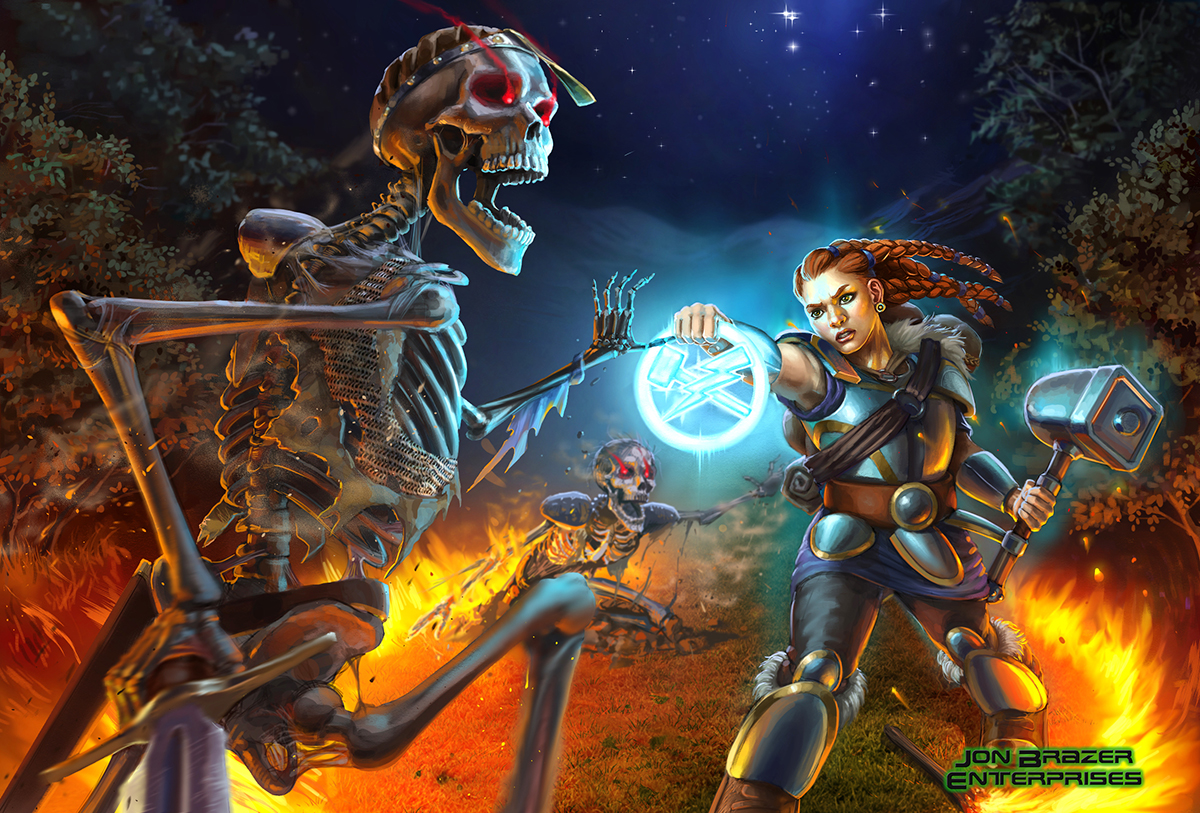
Gen Con Online 2020

I hope you are having a fun Gen Con this year. No matter where in the world you are, you can play in Gen Con this year. I hope that more conventions have an online component even after we go back to the way things were.

For this year, however, you can download JBE’s Pathfinder 1e, D&D 5e, 13th Age, and Traveller RPG at JonBrazer.com for 20% off with the coupon code GenCon2020.

Stay safe. Roll some dice and enjoy your games. Have a good con everyone.

Traveller: Terran Hypercycle G/Bike

Its been a while since I posted a new vehicle for Traveller and I thought. Since I discussed on the TravellerRPG forums about possibly working on the Solomani Worlds, I thought I’d make a vehicle and see how much interest there is such a territory.

If you want to see more in the Solomani Worlds, hit the Like button on the bottom of this post. Also be sure to check out all of our 2e Mongoose Traveller products like Foreven Worlds: Ships of the Border Worlds exclusively at DriveThruRPG.

Name Terran Hypercycle G/Bike
TL 15
Skill Flyer (grav)
Agility +6
Speed (Cruise) Supersonic (Subsonic)
Range (Cruise) 5,000 km (7,500 km)
Crew 1
Passengers 0
Cargo 0 ton
Hull 2
Shipping 0.5 tons
Cost Cr. 196,000
Equipment/Traits
Autopilot (Advanced), Communication System (Advanced), Computer/5, Control Systems (Advanced), Entertainment System, Open Frame, Sensors (Advanced), Streamlined

Autopilot (skill level) 3
Communications (range) 1,000 km
Navigation (Navigation DM) +4
Sensors (Electronics (sensors) DM) +2, 25 km
Camouflage (Recon DM)
Stealth (Electronics (sensors) DM)

Armour
Front 4
Rear 4
Sides 4

PF 1e: Curse Commander

Yesterday, we released the Book of Beasts: Magus Codex for Pathfinder 1e. We already previewed several NPCs including the apprentice mage, clan outcast, and the helltouched archer. Today we’re sharing one we couldn’t not create: the curse commander.

Approximately every other even-numbered NPC we present uses an archetype. One of our favorites is the hexcrafters. This witch-themed archetype gives the magus a completely different flavor and feel. Being able to use hexes as well as curses in conjunction with spellstrike can make life very difficult for anyone opposing them. In short, this is one formidable NPC. We lived this NPC so much, we made the image for it the cover for this supplement.

We hope you enjoy this NPC as well as the rest of the NPCs in this supplement as much as we had creating them.

Download the Book of Beasts: Magus Codex today at JonBrazer.com, DriveThruRPG, and coming soon to the Open Gaming Store, and Paizo.com.

Subscribe to the Book of Beasts: Character Codex Subscription today and get the Book of Beasts: Magus Codex as well as the Warpriest Codex at JonBrazer.com, DriveThruRPG, the Open Gaming Store, and Paizo.com.

Curse Commander CR 13

XP 25,600
Human magus (hexcrafter UM) 14
NE Medium humanoid (human)
Init +1; Senses low-light vision; Perception +4


Defense


AC 22, touch 12, flat-footed 20 (+10 armor, +1 Dex, +1 dodge); +2 vs. humans
hp 122 (14d8+56)
Fort +14, Ref +8, Will +11
DR 2/— vs. humans


Offense


Speed 60 ft., fly 70 ft. (good)
Melee +5 spell storing longsword +23/+23/+18 (1d8+11/19–20)
Special Attacks arcane pool (+4, 11 points), greater spell combat, hex arcana (cackle APG, charm APG, enduring blade UC, healing APG, misfortune APG, weather control APG), spellstrike
Magus (Hexcrafter) Spells Prepared (CL 14th; concentration +18)
5th—cloudkill (DC 19), overland flight
4th—bestow curse (DC 19), black tentacles, greater brand APG (DC 19), ice storm (2)
3rd—force hook charge UM, haste, keen edge, slow (DC 18), vampiric touch
2nd—bear’s endurance, blindness/deafness (DC 17), bull’s strength, disfiguring touch UM (DC 17), effortless armor UC, frigid touch UM
1st—ill omen APG, long arm ACG, mount, shield, true strike, vanish APG (DC 15)
0 (at will)—acid splash, brand APG (DC 15), detect magic, mage hand, ray of frost


Tactics


Before Combat The magus drinks the potion of heroism, uses arcane pool to enhance the weapon, and casts effortless armor, mount, and overland flight. Additionally, the magus casts bear’s endurance and bull’s strength on their cohort. The magus also casts keen edge on the arrows of any archers under their command.
During Combat The magus casts haste before charging into battle, attacking with the sword while mounted or casting area-effect spells such as black tentacles, cloudkill, and ice storm while flying.
Base Statistics Without arcane pool, the potion of heroism, effortless armor, haste, and overland flight, the magus has the following stats: AC 21, touch 11 (+10 armor, +1 Dex); Fort +12, Ref +5, Will +9; Speed 20 ft. (30 ft. without armor); Melee +1 spell storing longsword +16/+11 (1d8+7/19–20); CMB +14; CMD 25; Skills Diplomacy +13, Fly –4, Intimidate +16, Knowledge (arcana, dungeoneering) +21, Linguistics +18, Perception +2, Ride +13, Spellcraft +21, Use Magic Device +16.


Statistics


Str 19, Dex 12, Con 16, Int 18, Wis 10, Cha 8
Base Atk +10; CMB +17; CMD 26
Feats Combat Casting, Critical Focus, Extra Hex APG, Fast Learner ARG, Leadership, Spell Focus (necromancy), Spell Focus (transmutation), Surge Of Success ARG, Weapon Focus (longsword), Weapon Specialization (longsword)
Skills Diplomacy +15, Fly +12, Intimidate +18, Knowledge (arcana, dungeoneering) +23, Linguistics +20, Perception +4, Ride +18, Spellcraft +23, Use Magic Device +18
Languages Abyssal, Aklo, Aquan, Auran, Common, Cyclops, Daemonic, Dark Folk, Draconic, Dwarven, Elder Thing, Giant, Gnoll, Goblin, Ignan, Infernal, Orc, Terran, Worg
SQ fighter training (fighter level 7), heavy armor, hex arcana, hex magus, knowledge pool
Combat Gear potion of heroism; Other Gear +1 human-defiant full plate, +1 spell storing longsword, belt of physical might +2 (Str, Con), eyes of keen sight UE, headband of vast intelligence +2, magus spellbook (contains all 0-level spells and all prepared spells plus 1st—crafter’s curse APG, grease, shocking grasp, touch of combustion ARG, 3rd—heart of the metal ACG, 4th—dimension door, 5th—corrosive consumption UM, wall of force), 85 gp
PF 1e: Unleash the Magus Codex Upon Your Game

Characters to Bend Reality and Crush their Enemies
Do your PCs need to hire an extra sword arm with some arcane talent to boot? Does your upcoming session need an evil wizard that can go several rounds in a melee fight? Are you seeking ideas for the terrible power at the end of your campaign? The Book of Beasts: Magus Codex has the solutions you need, arming Game Masters of the First Edition of the Pathfinder Roleplaying Game with the following:

  • 20 ready-made magus characters, one for each level of play
  • Tactical combat recommendations for every character, helping you to quickly and effectively run the NPC in a fight
  • Personalities and details to give you ideas on how to use the characters both in combat and in roleplaying interactions

Populate Your Campaign With the Exact Character You Need!

Download the Book of Beasts: Magus Codex today at JonBrazer.com, DriveThruRPG, the Open Gaming Store, and coming soon to Paizo.com.

Subscribe to the Book of Beasts: Character Codex Subscription today and get the Book of Beasts: Magus Codex as well as the Warpriest Codex at JonBrazer.com, DriveThruRPG, the Open Gaming Store, and Paizo.com.

Pathfinder 1e: The Helltouched Archer

The Book of Beasts: Magus Codex comes out tomorrow and is already available to subscribers of the Book of Beasts: Character Codex Subscription. We shared with you some NPCs from the book, name the apprentice mage and the clan outcast. Today, I want to share with you the Helltouched Archer.

Before I do, I have to provide a bit of context for this one. One of the things we do before conceptualizing these NPC is to research all the books from Paizo and see what has been created before. I want to see what concepts have been done and more importantly which ones have not. We discovered that the magus was not a very common class for NPCs. I found approximately as many magus NPCs in all the adventure paths I searched as I found slayer NPCs in the Ironfang Invasion Adventure Path. While there may be more in others APs, but it does means there is quite a bit of opportunity to show atypical magi.

The magus’ class features highly encourages a melee-focused character. However, the lack of touch spell options lends the class to a typical wizard build, one that avoids melee combat (casting lightning bolt through a weapon attack means you are reducing the number of targets of that spell to one, greatly reducing the spell’s effectiveness, making it a suboptimal choice). The ranged build is not typical for a magus but is no less valid. Which brings us to the Helltouched Archer. By ignoring the spellstrike class feature, the NPC can attack a specific target with arrows and at large groups of targets with spells like fireball all in one turn. Suddenly this build went from an oddity to a formidable foe, one that should be seen as a very reasonable build for the class.

So we present you with the Helltouched Archer, the unusual NPC that should not be so unusual. You can find this and more as part of the Book of Beasts: Character Codex Subscription, available at the JBE Shop, DriveThruRPG, Paizo, and the Open Gaming Store.

Helltouched Archer CR 8

XP 4,800
Tiefling ARG magus 9
NG Medium outsider (native)
Init +4; Senses darkvision 60 ft.; Perception +0


Defense


AC 21, touch 14, flat-footed 17 (+7 armor, +4 Dex)
hp 71 (9d8+27)
Fort +8, Ref +7, Will +6
Resist cold 5, electricity 5, fire 5


Offense


Speed 30 ft.
Melee spear +7/+2 (1d8+1/×3)
Ranged +1 speed composite longbow +11/+11/+6 (1d8+2/×3) or javelin +10/+5 (1d6+1) or spear +10/+5 (1d8+1/×3)
Special Attacks arcane pool (+3, 7 points), improved spell combat, magus arcana (arcane accuracy UM, arcane edge UC, empowered magic UM), spell recall, spellstrike
Tiefling Spell-Like Abilities (CL 9th; concentration +7)
1/day—darkness
Magus Spells Prepared (CL 9th; concentration +12)
3rd—cloak of winds APG (DC 16), fireball (DC 16), lightning bolt (DC 16), versatile weapon APG (DC 16)
2nd—acid arrow, flaming sphere (DC 15), scorching ray, spider climb, stone call APG
1st—burning hands (DC 14), expeditious retreat, feather fall, hydraulic push APG, returning weapon UC, true strike
0 (at will)—acid splash, detect magic, disrupt undead, flare (DC 13), ray of frost


Tactics


Before Combat The magus casts cloak of winds and spider climb, then hides high up on a wall.
During Combat If facing evil outsiders, the magus casts versatile weapon on arrows, enhances the bow with arcane pool, and uses the oil of bless weapon if necessary to bypass DR. When fighting humanoids or similar, the magus throws javelins or spears and casts spells
with spell combat, spending the arcane pool on spell recall.
Base Statistics Without arcane pool, the magus has the following stats: Ranged +1 composite longbow +11/+6 (1d8+2/×3).


Statistics


Str 12, Dex 18, Con 14, Int 16, Wis 10, Cha 6
Base Atk +6; CMB +7; CMD 21
Feats Far Shot, Manyshot, Point-Blank Shot, Precise Shot, Quick Draw, Rapid Shot
Skills Bluff +0, Climb +11, Knowledge (arcana, planes) +15, Spellcraft +15, Stealth +13; Racial Modifiers +2 Bluff, +2 Stealth
Languages Abyssal, Common, Dwarven, Elven, Infernal
SQ knowledge pool, medium armor, prehensile tail ARG
Combat Gear oil of bless weapon, potion of cure moderate wounds, potion of jump, potion of shield of faith +2; Other Gear +1 mithral chainmail, +1 composite longbow (+1 Str), efficient quiver containing arrows (60), javelin (18), spear (6), magus spellbook (contains all 0-level spells and all prepared spells plus 1st—abjuring step UC, color spray, ray of enfeeblement, unerring weapon UC, 2nd—molten orb ACG, 3rd—haste, slow), 117 gp

Pathfinder 1e: Clan Outcast

We are going to be publishing the Book of Beasts: Magus Codex here soon so we are sharing with you some of the NPCs within. Previously we shared the Apprentice Mage. Today we are showing off the Back Ally Avenger.

When we are setting up each entry in the Character Codex series, we name each idea something we want to showcase or the basic concept for it. For some, this is the name of the archetype incorporated, like Spell Dancer. Others we name as a theme, like the Power Attacker. These typically get renamed during the creation process. For example, the Power Attacker became the Weaponbreaker, and the Spell Dancer became the Aerobatic Spellsword.

There is also a third category of names, ones that seldom get renamed. These are the ones with the story already behind them. This is the case of the goblin magus we named the Clan Outcast. Ones like this seldom have their names change during the creation process. Every choice made for this character was made because goblins are generally illiterate, so a goblin that could not only read but one that could turn those words into magic would be thrown out at best. My thought process from there went something like this:

So if the goblin got banished, they’d be smart enough to know that goblins don’t survive long on their own. They would need to join up with something more powerful. Living among humans is too obvious. Dwarves? No. Elves? Hell’s no. Let’s make this one live somewhere interesting, like with a dragon. Yea, the dragon teaches the goblin about magic while the goblin guards the dragon against smaller threats so the dragon can sleep on their pile of gold. Mutually beneficial.

That is the basic story behind the goblin we detailed for the Clan Outcast magus stat block. Blargg Firespitter is a pretty fun goblin, and this one already has a scenario set up for GMs.

Subscribe to the Book of Beasts: Character Codex and get the Magus Codex as soon as it is released. Download today at the JBE Shop, DriveThruRPG, Paizo, and the Open Gaming Store.

Clan Outcast CR 5

XP 1,600
Goblin ARG magus 6
CE Small humanoid (goblinoid)
Init +4; Senses darkvision 60 ft.; Perception +0


Defense


AC 21, touch 15, flat-footed 17 (+4 armor, +4 Dex, +2 shield, +1 size)
hp 54 (6d8+24)
Fort +7, Ref +6, Will +5


Offense


Speed 30 ft.
Melee +2 flaming short sword +12 (1d4/19–20 plus 4d6 fire)
Special Attacks arcane pool (+2, 7 points), magus arcana (pool strike UM, spell shield UM), spell combat, spell recall, spellstrike
Magus Spells Prepared (CL 6th; concentration +8)
2nd—fire breath APG (DC 14), molten orb ACG, scorching ray, web (DC 14)
1st—burning hands (DC 13), long arm ACG, mudball ARG (DC 13), touch of combustion ARG (DC 13), vanish APG (DC 13)
0 (at will)—acid splash, dancing lights, detect magic, mage hand, ray of frost


Tactics


Before Combat The magus enhances the short sword with arcane pool.
During Combat The magus spends arcane pool points first on spell shield to increase AC, then on pool strike to increase short sword damage, and then targets enemies with ranged spells.
Base Statistics Without arcane pool, pool strike, or spell shield, the magus has the following stats: AC 19, touch 15, flat-footed 15 (+4 armor, +4 Dex, +1 size); Melee +1 short sword +11 (1d4–1/19–20).


Statistics


Str 6, Dex 19, Con 14, Int 14, Wis 10, Cha 10
Base Atk +4; CMB +1; CMD 15
Feats Extra Arcane Pool UM, Toughness, Weapon Finesse, Weapon Focus (short sword)
Skills Knowledge (arcana) +11, Knowledge (dungeoneering) +11, Ride +8, Spellcraft +11, Stealth +18; Racial Modifiers +4 Ride, +4 Stealth
Languages Draconic, Dwarven, Goblin
Combat Gear pearl of power (1st level), potion of cure light wounds, potion of jump, potion of protection from good, potion of remove fear, alchemist’s fire; Other Gear mithral chain shirt, +1 short sword, magus spellbook (contains all 0-level spells and all prepared spells plus 1st—color spray, corrosive touch UM, expeditious retreat, feather fall, shield, true strike), 20 gp

The Changing Digital Landscape by the Numbers

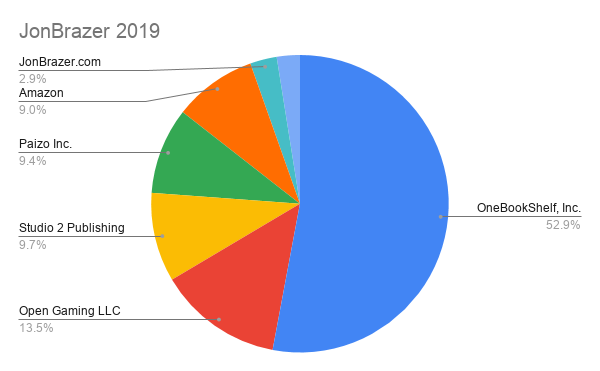
2020 has been a challenging year for everyone. RPG Publishers are no exception. Being an engineer by training, I wanted to see the numbers of how this year is different than other years. With that in mind, I present to you JBE’s sales by location for June 2020 and compare the above chart with the one we did for 2019 (see right below).

In both pie charts, DriveThruRPG comes out on top and is approximately 50% of the market. Both Paizo and Amazon held on, each having about 8-9% of our sales.

That is where the similarities end. Studio 2 is not on the new chart. This is partially my fault as I have sent nothing new to distribution for a while, but from what I am hearing game stores are having a tough time of it right now. In times like these, I imagine they are stocking products that sell easier, like RPGs from Wizards and Paizo. the Open Gaming Store went down slightly, but that could simply be a one-month variance. The JBE Shop nearly tripled. While that also could be a one-month variance, I’ve noticed an uptick in sales from my own site for the year as a whole.

Then there’s Fantasy Grounds. On last year’s chart, Fantasy Grounds is that tiny unlabeled sliver. That was approximately 2% of our sales. June 2020 has them as our #2 selling location, approximately 18% of our sales. That’s an 800% increase. Even better that wasn’t our best month of sales this year.

So there is definite growth here, and when the world goes back to normal, I do expect some people to continue to play games over the internet. People are discovering they are no longer constrained by location; you do not need to look for someone to game with within an hour’s drive of you. You can now game with people in different time zones.

So no matter how you game, check out all of our online stores, but it the JBE Shop, DriveThruRPG, Fantasy Grounds, the Open Gaming Store, Paizo, and of course Amazon.

Convention Games over Fantasy Grounds Classic

During the pandemic, I’ve been running a number of games online over Fantasy Ground Classic. Since many are new to the platform, I’ve been sending out instruction each time to help new players get connected. So instead of typing it out again and again, I’m just posting this once and will be pointing new players to this page. GMs, if you are running convention games over Fantasy Grounds Classic and you have an Ultimate License (such as myself), feel free and point your gamers here so they can find out how to set up FG Classic for the first time. If you are playing an RPG over Fantasy Grounds Classic, follow these steps to set up the program and connect to the game:

  1. Goto the following site: http://www.fantasygrounds.com/home/FantasyGroundsClassic.php
  2. Choose Mac or PC. Download and install.
  3. Once you do that, you’ll get a window that asks for your license key at the top. Just click OK at the bottom without entering anything. This will let Fantasy Grounds run in “demo” mode.
  4. You’ll be asked to log in to your Fantasy Grounds account or create one. It’s free.
  5. A new window will open. Click “Join Game.” You’ll be met by two boxes. The first labeled: Username. Please type in your real name (first name only is fine). This makes it easy for a GM to refer to you during game (your character’s name will be elsewhere). The second is labeled Host Address. That information, you will get for registering for the game. Once you enter that information, click the Start button.

It is always best to do this a day or two (or more) before the game so you can find out if you have any issues installing the program and can figure out other options.

This should get you started in online gaming. Enjoy virtual game, and I hope to game with you at Gen Con Online, or any other online convention.

If you run games over Fantasy Grounds (Classic or Unity), I encourage you to check out all of our products at the FG Store. We are adding more products there all the time so check back frequently.

3 Rules for Creating Compelling Fantasy Religions

Whether you are creating your own setting or just adding your own flare to an existing setting, creating your own fantasy religions can be fun for both you and your players. The gods and their religions is a way to emphasize something important in your campaign. Learning more about the god of stealth is important when fighting the thieves’ guild; discovering a particular blacksmith is a follower of the deity of war equipment may tip off the players to the NPC being more than they appear.

So how can you go about making your own, without shamelessly ripping off real world religions? Before I answer that, I wholeheartedly endorce “borrowing heavily” from mythology. Some exceptional tales are there and are a classic for a reason. Pick up a book on them, read and borrow.

But if you still feel you need to create a religion from whole cloth, I have three rules for you to follow.

1) Pick a Theme and Run With It

Start with a core concept that is going to be important enough that it could draw followers. Clearly define it in 1-3 words: war, art, thieving, servants, farming, birds, a particular celestial body, and crafting are but a few examples. Now take that core concept and let your mind wander on what else is related to that theme. Servants work hard all day long for little reward. Who else does that? Employees. So this moves beyond a Noble’s servants and incorporates the baker’s lowly assistant, the dock workers, the one that cooks for to the caravan guards, and so on. So this deity is not a god of servants, but a god to the downtrodden. When the downtrodden are about to be beaten by their master’s for some minor mistake (or because the master is in the mood), they call upon their deity and the deity shows them some place to hide, perhaps even helping them to plan for such eventualities. So this deity is also a god of forethought and hiding places. Now this deity is both fun and more fleshed out than just “servants.”

2) Add in Something Unexpected … And DON’T Explain it.

Players will latch in to that oddity and think about that far longer than anything else, trying to figure out how they work together? Why does the deity of understanding, reason, and time have a groundhog as their spirit animal? Sure it makes total sense if you’ve seen the movie Groundhog Day, but if you hadn’t, how long would you try puzzling that one through. More importantly, what crazy ideas would you come up with trying to make that one work.

The most important part of this step is to limit it to one or two things. Anything more and the theme to your carefully thought out deity starts to look like a collection of random ideas rolled up together. This is definitely a less-is-more situation. Take the deity of servants from the previous step. What if we make them associated with purple flowers? Or instead its sacred animal is a particular breed of goldfish? Maybe followers should always turn their glass or bowl of water counterclockwise three times before taking their first drink for the day. Obviously, there is a perfectly logical explanation for whatever oddity is chosen, but leaving such reasons said unspoken both adds an heir of mystery and makes the world feel more lived in. Besides, it is entirely possible no one knows why such oddity is the case. It could have been lost to time over the last 1,000+ years. Maybe the deity never felt the need to explain such oddities to their followers. Heck you could make the answer explainable should someone ask, but they have to ask someone in world so they can give an in-world explanation. No matter what it is, treat it as ordinary as a Catholic priest putting a wafer into your mouth saying that it is from the body of someone that died about two thousand years ago and you should eat that dead person’s flesh.

3) Describe How Mundane Followers Interact With Their Faith

In my experience, this more than anything else is forgotten by game designers and GMs when describing religions. While the religion is focused around the deity/deities, the followers are no less important. Without followers, gods lose power. Terry Pratchett described this relationship perfectly in his book Small Gods. The great god Om said several times throughout the book, “Smite you with lightning bolts!” when he got angry at someone, yet nothing happened until he gained a single follower. Even then, he got hit with the equivalent of static electricity. When many people believed in him, he swelled with power.

Mind you, that book was really about how the people in the church of Om had no faith and simply did the ceremony without knowing the reasons why. However, a religion without some type of regular way for the followers to participate in is a religion that is going to lose followers. How many books are forgotten after their author dies? Sure some classics are remembered, like Mary Shelley’s The Modern Prometheus is well remembered, but Percy Shelly is not nearly as well remembered despite the fact he was an established author when his wife created Dr Frankenstein and his monster. Same idea.

So yes, any religion needs a consistent way for the followers to interact with their faith. All of these should interact with stuff we decided above. Prayers at select times or for certain reasons. Eating / not eating certain foods on certain days. Regular community gatherings with preferred offerings. Ceremonies to mark important events in the religion as well as the lives of the followers. Perhaps the god of servants has a ceremony marking someone’s promotion. Similarly, prayers for enough energy and strength to make it through a hard day’s work comes at dawn while prayers of protection against an angry master’s wrath can come at any time. Compare that with a god of intellect and arcane study: prayers to that deity should be before sitting down at a desk to do some heavy reading and study. That same deity probably talks about the evils of eating excessive carbs as they will make one drowsy before a long night of study by candlelight.

I hope these tips help you create compelling religions in your game. Be sure to check out all of JBE’s Pathfinder 1e, D&D 5e, 13th Age, and Traveller at DriveThruRPG and the Open Gaming Store. Subscribe to our Patreon if you want to see more blog posts like this.

Pathfinder 1e: Steal Strength

As I’ve mentioned before, working on the Book of Beasts: Magus Codex has shown me the many holes in their spell selection particularly their lack of touch spells. The magus class is built around delivering touch spells through your weapon. However, there are far too few touch spells making the close range arcana necessary.

To address this, we are working on a bunch of new touch spells for the magus with a number of other classes benefitting as well. We’ve shown off the 1st level spell frigid grasp and the 2nd level spell tarfoot. Today we’re talking the steal strength spell for 3rd level.

Download our Pathfinder 1e PDFs at DriveThruRPG, the Open Gaming Store, Paizo, and our own store at JonBrazer.com.

Steal Strength

School necromancy; Level arcanist/sorcerer/wizard 3, bloodrager 3, magus 3, witch 3
Casting Time 1 standard action
Components V, S
Range touch
Target creature touched
Duration 1 round/level
Saving Throw Fortitude half; Spell Resistance yes
The subject takes a penalty to Strength equal to 1d4 per three caster levels (maximum 5d4). The subject’s Strength score cannot drop below 1. A successful Fortitude save reduces this penalty by half. This penalty does not stack with itself nor similar penalties such as from ray of enfeeblement. Apply the highest penalty instead. Half of the Strength penalty taken by the target from this spell is granted to you as an enhancement bonus for the duration of this spell.