So I’m enjoying the new campaign setting. I want to jam some spells sometime. I love these old campaign settings. They do not get nearly enough love. I’m looking forward to scaping the planes next year as well. But I digress.
So I created a baby space whale. I mean why have the adult space whales and not the baby ones. So anyways, I hope you enjoy them.
Spaceborn. Baby space whales do not eat, drink, or breathe.
Actions
Tail. Melee Weapon Attack: +8 to hit, reach 5 ft., one target. Hit: 16 (3d6 + 6) bludgeoning damage. Flaring Light (Recharge 6). The baby space whale emits light from its head. All creatures within 60 feet must succeed a DC 13 Wisdom saving throw or have disadvantage to all attack rolls or skill checks until the end of the baby space whale’s next turn. A successful save means the creature is immune to this ability for 24 hours.
When it comes to being a small publisher, you love every single one of your fans. They are devoted people who love what you make, and their words of encouragement mean the world to you. Some people want to go a step further and help their favorite small publisher thrive. They always want to know what they can do to help keep the publisher going. I never feel that a social media post is a good place to really talk about it. So I decided to write a blog post on the topic. Here are 3 things you can do to help your favorite small publisher. And these are true whether JBE is one of your favorite small publishers or it is someone else. I guarantee you that no matter what small publisher they are, they will appreciate you doing these.
1) Tell Your Friends
Far and away, the best thing you can do to help is to talk about us to your friends. One conversation with your friends where you say that this spell from this book or this character option from this PDF from “one of my favorite publishers” means so much more than all the advertising dollars and Facebook posts in the world. Your words to your friends are really invaluable. I really can’t stress this one enough. It really does make a huge difference.
2) Social Media
The algorithms on social media promote engaged posts. So if you see your favorite publisher post something, like it, heart it, give it an upvote, etc. If it is Facebook, don’t just like it; give it a heart, a wow, or one of the other likes. These tell the algorithms that this post is better than a basic like and will help it go further. And definitely comment. Comments help social media posts go much further. If there’s a new product or a sale, share the post to your own page and tag your friends who might also like it.
3) Join Their Mailing List
DriveThruRPG’s Mailing List
Whether you are joining the mailing list of the company itself (like you can do right here for JBE) or letting them send you emails through DriveThruRPG. Our DriveThruRPG email list is the best way to stay connected with the company if you want to stay informed about new products or sales of current products. In contrast, the company mailing list is the best way to keep current about anything the company is doing in general. Signing up for either will help the publisher engage with you.
Last week, I posted my initial reaction to the One D&D Announcement. In it, I said that I believe that the OGL is going away. I’ve gotten a few questions on why I believe that to be the case. So instead of repeating them over and over again, I’m sharing them here. But first, some history.
Why Was the OGL a Success?
The Open Gaming License (or OGL) was created as a way for fans and businesses to be able to create their own products that can be used with D&D 3e without fear of being sued over. That fear was legitimate since TSR did exactly that. Because of that, gamers saw 3e as their edition, one where they could create their own material and share it with the world. Not only that, the OGL opened a great pathway for publishers to create their own material that gamers could buy. This material frequently filled niches that Wizards felt were not profitable enough to explore themselves. Want an all-animal race setting? There’s an OGL product for that. Want a super-high-level adventure? There’s an OGL product for that. Want your game to be more like a superhero comic book? There’s an OGL product for that.
Wizards benefited from this. The OGL increased core book sales because the core book was still required to play the game, no matter how far from a standard D&D game they ventured. Many of their past and current designers cut their teeth by creating OGL products. It was a great proving ground for creators.
Why Do I Believe the OGL Will Go Away in D&D 6e?
Wizards never liked the Open Gaming License, even in the 3rd edition era when they introduced it. It was work for them that never directly made them money. All the reasons I mentioned above about benefits to Wizards, none of those arguments have a direct dollar sign next to it saying, “the OGL brought us this much money.” So there is no business reason to maintain it.
Additionally, Wizards felt they had no control over it. The Book of Erotic Fantasy soured what little goodwill they still had towards it; their game was associated with something they felt was not up to “community standards.” Sure the d20 logo was pulled from that book, but it was still a blemish the OGL never recovered from in their minds.
Wizards tried replacing the OGL with the GSL (or Game System License) in the 4e days, which turned out disastrous. The license was obviously inferior, more restrictive, and felt mean-spirited like they knew they had to put out some license, and this was all they were willing to do. 4e was not your edition; it was theirs. They had taken their ball and went home. 4e was given a black eye for abandoning a license that was far more restrictive and could end at any time. In fact, that license did end with a forum post on a website not owned by Wizards.
So after 5e was released, Wizards released an OGL version at the same time as launching the DMs Guild. The DMs Guild made D&D a fan’s edition again. It offers a way to write in-setting content—something the OGL never had—in exchange for more control over what was being produced. Most importantly, however, it added a very definite line in Wizards’ budget saying that this license directly made them so much money. And it has been exceptionally profitable for them.
Take Monster Manual Expanded III, for example. That book regularly costs $35. For the sake of argument, say Wizard’s cut is 20% (I don’t know if it is exactly this, but it is in the ballpark). That means Wizards makes $7/book. It has sold over 5000 copies. So they probably netted $35,000 off a book they spent absolutely nothing to create or promote. And that is one book. I should note that that number may very well be lower due to sales and similar, but it could be higher since we have no idea how many beyond 5,000 copies were sold to date.
The OGL has never had that. No OGL book directly made Wizards any money. Not only that, the majority of the hit 5e products are DMs Guild instead of OGL products. I mean, why look for an OGL product to use in your Forgotten Realms game when you can just get a DMs Guild product already in the FR? On top of that, DMs Guild products have a stronger sense of legitimacy than OGL products ever possessed.
So if Wizards maintains the DMs Guild for 6e and just says, “The OGL is coming,” and it never materializes, it is not something that the fan base will reject the new edition over.
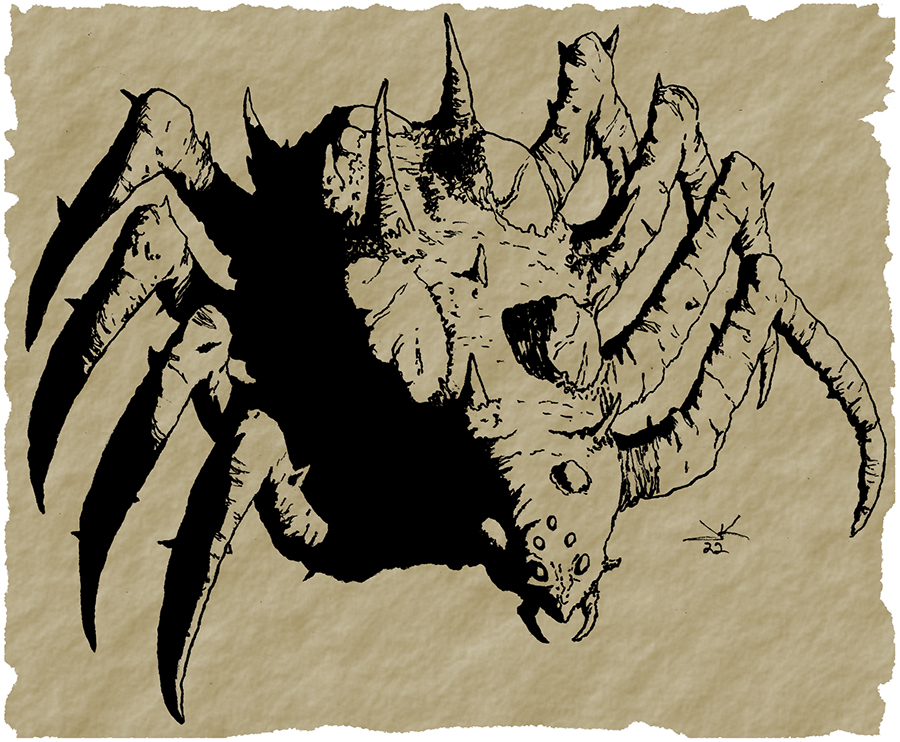
I mentioned in the PF 1e version of the Corrupted Spider that I have not made monsters in quite some time. So that is something I’m going to try to do for a while: make PF 1e and 2e versions of the same monster. This monster is obviously based on the hunting spider, but I increased the challenge rating and themed it to be more demonic. Tell us what you think in the comments below.
Uncommon CE Large Fiend Perception +11; darkvision, web sense Skills Acrobatics +10, Athletics +12 (+15 to Climb), Stealth +10 (+12 in web) Str +5, Dex +6, Con +4, Int –5, Wis +3, Cha –4 Web Sense The corrupted spider has imprecise tremorsense to detect the vibrations of creatures touching its web.
AC 20; Fort +11, Ref +14, Will +8 HP 60; Weaknesses cold iron 5, good 5 Spring Upon Prey [Reaction] (attack); Requirement Initiative has not yet been rolled. Trigger A creature touches the corrupted spider’s web while the spider is on it. Effect The corrupted spider automatically notices the creature and Strides, Climbs, or Descends on a Web before it rolls initiative.
Speed 25 feet, climb 25 feet Melee 1 bite +12 (agile, evil, finesse, poison), Damage 2d6+5 piercing plus corrupted spider venom Ranged 1 web +12 (range increment 30 feet), Effect web trap Corrupted Spider Venom (poison); Saving Throw Fortitude DC 20; Maximum Duration 6 rounds; Stage 1 1d6 poison and flat-footed (1 round); Stage 2 2d6 poison, enfeebled 1, and flat-footed (1 round); Stage 3 2d6 poison, enfeebled 2, and flat-footed (1 round). Descend on a Web 1 (move) The corrupted spider moves straight down up to 40 feet, suspended by a web line. It can hang from the web or drop off. The distance it Descends on a Web doesn’t count for falling damage. A creature that successfully Strikes the web (AC 22, Hardness 4, 6 HP) severs it, causing the spider to fall. Web Trap A creature hit by the corrupted spider’s web attack is immobilized and stuck to the nearest surface until it Escapes (DC 22).
The overwhelming majority of creatures that find their way to the Abyss end up either ripped apart by demons or other denizens for pure enjoyment. Those that not only survive but thrive in this environment for generation after generation end up changed by it, becoming one of the horrors of this dreadful place. Vermin are most often the creatures that undergo this change with spiders being the undisputed masters of being foul creatures that survive this change.
While they are no smarter than their mundane counterparts, corrupted spiders are larger, stronger, and more deadly than those found on the Material Plane. Even worse, they gained some of the protections that the creatures native to this plane possess. Generations of these creatures feasting upon demons will impart their natural biology upon them. They still remember their taste for humanoid flesh and will ensnare such prey at their first opportunity.
I talked a bit last week about my Initial Reaction to One D&D. Today, I’d like to start talking about the specifics. But before I do that, I would like to address the reaction to the name “One D&D.” I seriously doubt that this will be the final name for the new edition. In fact, I fully believe that when the final version launches two years from now that it will be called Dungeons and Dragons 6th Edition, even if the 6e part is downplayed. The reason for that being is that 10 years ago, when 5e was being developed, it was called D&DNext, calling it the “Next Iteration of Dungeons and Dragons,” and yet they still called it D&D 5e when it was all done. So I expect them to follow the same pattern this time around.
Anyways, onto racial specifics. Let me start by saying that I am really freaking glad that they FINALLY included orcs as a core book playable race. This is a long time coming and is long overdue. For those who don’t know, orcs, as described by a certain fantasy author, were modelled on racist wartime propaganda caricatures of the Japanese. Specifically that they are antithetical to civilization and possessed no redeeming qualities. Let me be abundantly clear that myself and everyone in my company are steadfastly against such a view; such bigotry does not belong in the world. Early editions of the game reflected this view, making orcs a race that could be slaughtered without feeling bad about it. That view has changed over time. More modern editions of the game describe them as possessing “love, compassion, and empathy,” making them more than capable of choosing their own path in life. Orcs are a noble race of warriors and poets, hunters and gatherers, defenders of the wild lands, and protectors of traditions. Their inclusion as core playable races is something that should have been done a long time ago, and I am glad to see it done.
The other new core book race is ardling. These are obviously supposed to be the counterpart of tiefling. Again, I am glad to see their inclusion. I never liked the inclusion of tiefling without some descendent-of-good-creatures peer. However, I’m kind of “meh” that that is all. I mean there are so many other possibilities that could be included. Why not include a catfolk race or fey race or a construct race or a turtle-people race? These are far more interesting than elves and dwarves will ever be to me.
And while I am at it, I am disappointed to see that they are still using the term “race.” Other games have moved on from it, acknowledging that it is a charged term. Breaking a tradition is never easy, but using this term is one that should be broken. Wizards really should change the term race to something else. “Heritage” is used by Pathfinder. “Kin” is used by 13th Age. Pick one and run with it.
Long-time JBE fans will know that I consider myself to be, first and foremost, a monster creator. Give me a piece of artwork of something new and unusual, and I’ll make you something to terrify your players with. I haven’t created a monster in quite some time. Life and other distractions got in the way and I just haven’t done that in a while.
Well, it is time to change that. Especially considering that Fat Goblin Games just ran a sale on their artwork, and I snatched up quite a bit by Jeffrey Koch. My creative juices are flowing, and I am excited. I know this first one isn’t awe-inspiringly new, but it is a first creation while I’m dusting off the old gears. I hope you enjoy it in your game.
DriveThruRPG has a sale of Pathfinder products going on now. Grab JBE’s Pathfinder titles while they are up to 40% off.
Corrupted SpiderCR 4
XP 1,200 CE Large outsider (augmented vermin) Init +4; Senses darkvision 60 ft., tremorsense 60 ft.; Perception +6
Defenses
AC 17, touch 13, flat-footed 13 (+4 Dex, +4 natural, –1 size) hp 42 (5d10+15) Fort +7, Ref +8, Will +3 Defensive Abilities 5/cold iron or good; Immune mind-affecting effects
Offense
Speed 30 ft., climb 30 ft. Melee bite +6 (2d6+2 plus poison) Special Attacks web (+8 ranged, DC 15, hp 5)
Statistics
Str 15, Dex 19, Con 16, Int —, Wis 14, Cha 2 Base Atk +5; CMB +8; CMD 22 (34 vs. trip) Skills Climb +18, Perception +6 (+10 in webs), Stealth +4 (+8 in webs); Racial Modifiers +4 Perception, +4 Stealth (+8 in webs), +16 Climb
Ecology
Environment any Abyss Organization solitary, pair, or colony (3–8) Treasure incidental
Special Abilities
Poison (Ex) Bite—injury; save Fort DC 15; frequency 1/round for 4 rounds; effect 1d3 Strength damage; cure 1 save.
The overwhelming majority of creatures that find their way to the Abyss end up either ripped apart by demons or other denizens for pure enjoyment. Those that not only survive but thrive in this environment for generation after generation end up changed by it, becoming one of the horrors of this dreadful place. Vermin are most often the creatures that undergo this change with spiders being the undisputed masters of being foul creatures that survive this change.
The overwhelming majority of creatures that find their way to the Abyss end up either ripped apart by demons or other denizens for pure enjoyment. Those that not only survive but thrive in this environment for generation after generation end up changed by it, becoming one of the horrors of this dreadful place. Vermin are most often the creatures that undergo this change with spiders being the undisputed masters of being foul creatures that survive this change.
While they are no smarter than their mundane counterparts, corrupted spiders are larger, stronger, and more deadly than those found on the Material Plane. Even worse, they gained some of the protections that the creatures native to this plane possess. Generations of these creatures feasting upon demons will impart their natural biology upon them. They still remember their taste for humanoid flesh and will ensnare such prey at their first opportunity.
I’ve heard this refrain over and over again my entire gaming career, ” Spellcasters are overpowered. Their power needs to be nerfed.” While I do understand that a spellcaster’s power can overshadow the martial characters with a single spell, once that single spell is used, they probably do not have much left. This is doubly true at the higher levels. Here are my reasons why I believe that spellcasters of all stripes are not overpowered.
1) You’re Not Playing the Same Game
Playing a martial character is all about tactics. Fighters and paladins need to position themselves where they can stop the monsters from advancing upon the spellcasters. Rogues need to get themselves into a position where they can sneak attack. Barbarians should be where they can hit as many targets as possible. Rangers should find someplace where they can use their bows to hit whoever needs to be taken down. Monks need to stay mobile, moving through the battle space.
That is not the spellcaster’s game. Instead, a spellcaster needs to focus on resource management and opportunity costs. “Is the one fireball I prepped today best used now or later?” “This is my best spell, but the monster has resistance to its damage type. Should I use it or save it and use some other spell that does much less damage?” “Would it be better to buff the fighter or take out the monster attacking the cleric?” These types of questions are asked by every gamer that plays a spellcaster. Every spell they cast is a question of now vs later. They never know if what they’re doing is going to be overkill or a complete waste of resources. So when a spellcaster completely overwhelms the enemy with a single spell, it probably means that they will have very weak spells when they really need them. Spellcasters are more difficult to get right than most martial classes.
2) A Poorly Prepared Spellcaster is Useless
in my current home game, my 2nd-level cleric prepared protection from evil. We didn’t fight any evil creatures today. As such, that is one spell slot that sat useless. When you only have 4 slots, that is a quarter of the character’s main power. So I had to resort to my mace, and I rolled poorly. So my character was useless. But that’s beside the point.
A fighter can have a golf bag of bane swords on their back and can select the right weapon at the start of combat or switch it up in the middle as the dynamics of the battle change. Spellcasters don’t have that option. The spells they prepped at the start of the day or chose when they got their last level are all they have. If what they prepped does not work for this particular combat, they are probably staying in the back using their crossbow, if they have a crossbow.
What’s even worse is when they prepared well but the circumstances completely change on the group. If you are going into an ice cave and the spellcasters prepared fire spells, they are useless if the group gets sucked into a portal that takes them to the plane of fire. All those martial characters, they’re just as effective as before. Spellcasters can go from running the table to running away pretty quickly.
3) Combat Effectiveness Can Be Limited by Utility
Spellcasters a considerable amount of out-of-combat utility spells at their disposal. Whatever situation they run into, there is a spell somewhere to handle that. Putting aside whether or not they prepared the spell that day, there is an opportunity cost to it. Prepare knock to open a locked door? That is one less scorching ray they can do. Need to teleport a long distance? That comes at the cost of one less cone of cold. Making a mud wall so you can turn it into a stone wall with transmute mud to rock to protect the town from an enormous monster? Then they will have one less opportunity to cast hold monster that day. I can go on and on, but you get the idea. Rogues, unlocking one door does not mean they have to sacrifice their next sneak attack for it. Fighters, they don’t need to make mud walls, they can just pile the stones on top of one another to make the wall stone from the beginning.
Then there’s my personal favorite example: greater invisibility. While this example is PF 1e, the basic principles apply to any game system. Greater invisibility is a 4th-level spell, so you have to be minimum 7th-level to use it (8th for arcanists and sorcerers, 10th level for bards). So lets say it won’t see regular use until 10th-level. With it you can attack and stay invisible.
Compare that with sniping that anyone can use with he Stealth skill. But lets look at it with a rogue. At 1st-level, the rogue takes a –20 to Stealth checks to hide after attacking that round. That’s pretty bad, sure, but when you check out the Perception entry, you discover that if the person is distracted (like because they’re in combat), the hiding person gets a +5 bonus. And then there’s a +1 bonus per 10 feet the hiding person is away from the looker. Sniping requires a minimum of 10 feet, so that’s a minimum bonus of +6, making that penalty now –14. Naturally, the rogue would have a skill point in Stealth, the +3 bonus for it being a class skill and minimum Dex bonus of +3. Now that penalty is –7. Its opposed by the looker. If the rogue chooses someone that has no skill ranks in Perception and probably doesn’t have a Wisdom bonus, like a wizard or sorcerer, then they don’t have any bonuses at all to the roll. Still, at 1st level, that’s a sizable difference.
At 7th level (the minimum level to cast greater invisibility), the rogue added skill ranks to Stealth, bumped up their Dexterity ability, and probably even took the Skill Focus (Stealth) feat. Meanwhile, the spellcaster probably didn’t do anything to increase their ability to see someone. That net –7 is now a +3. That means the rogue has a better than even chance of doing exactly the same thing as greater invisibility every single round with absolutely no resource cost. In fact, Stealth is better than greater invisibility since Stealth is invisible to tremorsense, see invisibility, and true seeing while greater invisibility is not.
Wait until 10th level—when a bard can cast it at all—and a rogue can take the stealthy sniper advanced talent and take 10 off the penalty figured into the mix. That means, the rogue would have a net +19. Literally, the rogue would have to roll a 1, and the wizard would have to roll a 20 for the wizard to know where the rogue is.
Mind you, the wizard would be all too aware where the rogue is approximately and can send a fireball their way, but the rogue will probably pass the DC and take no damage thanks to evasion.
My point is, a wizard can cast greater invisibility once each time it is prepared. Rogues can sneak and snipe all day long. No limit.
I know I rambled on that last point, but you get the idea. Spellcasters are not nearly as overpowered as people think they are and attempts to even out their power generally make a difficult class to play far more difficult.
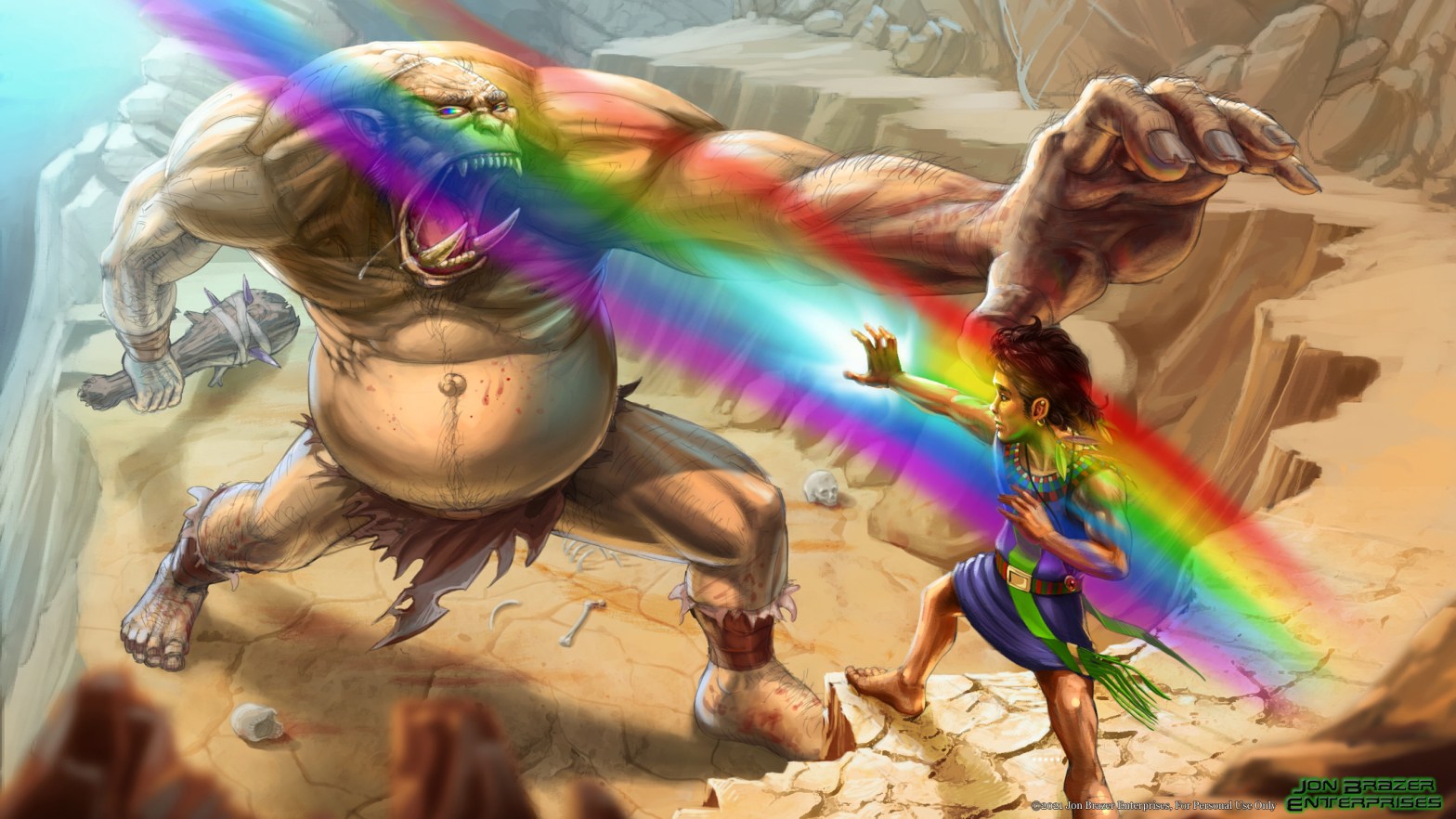
Wizards make ogres taste the rainbow. Image by Luis Salas Lastra
If you haven’t seen it yet, Wizards of the Coast announced the playtest of their new edition, which they’re calling One D&D. I’m not going to tell you what’s in it; you can read it for yourself and see the direction they want to go.
Personally, I like some things and I don’t like some things. But frankly, what I don’t like is such a minor quibble that it’s not worth mentioning. What do I like about it? Well, it seems like there will be more mechanical options.
That was my single biggest gripe with 5e. You choose your subclass at it before third level, and that’s the last choice you have for your class. I left 5e because the simplicity was not to my taste. I never felt the more complex options were not what I wanted. To compare it to bikes, I would describe 5e as ranging from a bicycle with training wheels to a tricycle. Meanwhile, I want a performance unicycle with someone balancing on my shoulders. But again, that’s my personal tastes; to each their own.
To me, it looks like 1DnD will be more complex, and I can only see that as a good thing. I’m sure there will be plenty of low-complexity options, and that is a good thing. New players need easy-to-play options, and some more experienced people just prefer that play style.
Now to a prediction: I don’t expect to see this edition to have an OGL. Oh, it DEFINITELY will have the DMs Guild. That money maker WotC will never get rid of. But the OGL, nope. I fully expect to see them walk away from that.
If you want a more complex game, I recommend checking out Pathfinder, either 1e it 2e. And you can grab our titles for these games at DriveThruRPG, the Open Gaming Store, and Paizo.
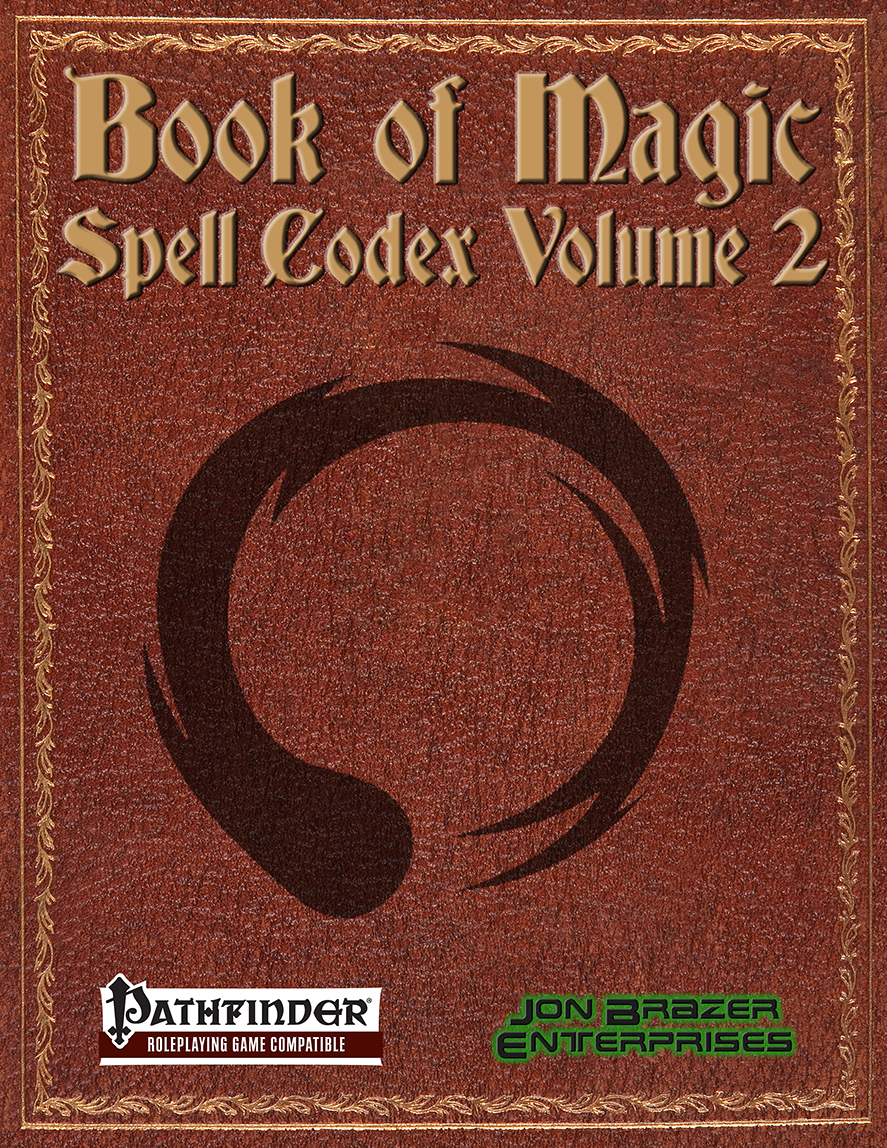
The Book of Magic: Spell Codex Volume 2 was released earlier this week. We’ve shared several spells in the book already, like planned assault and conjure deadfall, as well as discussing the winners of the book. Something we hadn’t shared yet is the artwork within.
Above is several images within. Mind you, they’re all black and white. That is not how they’re presented in the book. The white is transparent, letting the parchment background show through. This means that on every page, the imagery appears like it belongs there like it is part of an ancient tome. Unless you’re looking at it in the included printer-friendly version, then all these images appear as above. Check on the images to see a larger version of themselves.
Download the Book of Magic: Spell Codex Volume 2 today at DriveThruRPG, the Open Gaming Store, and Paizo.
Bringing together all the spells from two dozen companion sources, the Book of Magic: Spell Codex Volume 2 has something for everyone. These spells have been updated for clarity and expanded to cover classes introduced after their original publication. Gathered together for the first time, these spells will give your character the edge you’ve been looking for.
Within these 96 pages, the Book of Magic: Spell Codex Volume 2 contains:
Over 180 spells for all 26 spellcasting classes. From wizard to bloodrager, cleric to paladin, psychic to medium, you’ll find spells for your character here.
New short descriptions, making it easy for you to discover and find that perfect spell.
Artwork to make this feel like a true spellcaster’s tome.
Two fully bookmarked PDFs include a spell-tome-inspired design and printer-friendly version.
With this essential compendium, your character will be prepared for the road ahead.
Download the Book of Magic: Spell Codex Volume 2 today at DriveThruRPG, the Open Gaming Store, and Paizo.





 Jon Brazer Enterprises