Traveller: Defense Walker

Previous vehicle we shared (Zargrav X-72, Zaspa T-68 Skyhopper, Cyberpuma, and Hypercycle) were not combat vehicles. Today that changes. This military walker is created by the Confederation of Worlds (Die Weltbund). Warpride and other Confederation worlds use this defensive walker to repel invaders. They travel so slow that they need airlifted to the region they are needed. Once there, they can take serious punishment from its opposition and deal incredible damage to everything in their path.

Defense Walker

TL 10
Skill Drive (walker)
Agility +2
Speed (Cruise) Very Slow (Idle)
Range (Cruise) 300 (450)
Crew 1
Passengers 0
Cargo
Hull 60
Shipping 10 tons
Cost Cr. 2,285,825

Armour

Front 39
Rear 39
Sides 39

Details

Autopilot (skill level) +1
Communications (range) 50,000 km
Navigation (Navigation DM) +2
Sensors (Electronics [Sensors] DM) +1, 500 km
Camouflage (Recon DM) –2, 0.5 km
Stealth (Electronics [sensors] DM) –2

Weapons

Weapons Range Damage Magazine Mag Cost Traits
Gatling Lasers (2) 4 km 6D Auto 4

Traits/Equipment

Autopilot (Improved), Camouflage (Improved), Communications (Improved, Encrypted, Increased Range), Controls (Enhanced), Ejection Seat, Navigation (Improved), Sensors (Improved, Increased Range), Stealth (Improved)

The Defense Walker is produced by the Confederation of Worlds. Warpride is in the CoW and is one of the detailed worlds in Foreven Worlds: Alespron Subsector. Download this subsector at JonBrazer.com. You can also find it at DriveThruRPG and RPGNow.

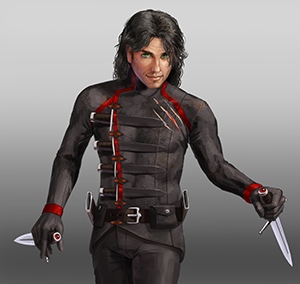
5 Questions Every Rogue Should Be Able to Answer

Comparing a fighter with a rogue is a healthy exercise and helpful when trying to understand how these characters are fundamentally different. When in a fight, a fighter walks up to the thing and beats it down until it is dead while a rogue will look for the creature’s weak point and strike there. When trying to get something from a cave where a monster lies sleeping, a fighter will most likely wake it up with the clanging of its armor and then have to kill it before getting the treasure while a rogue will quietly sneak past it and just take it. When trying to talk their way into a room past a guard, a fighter will try to intimidate the guard into letting them pass while a rogue may intimidate but will more likely turn on the charm and convince the guard that they should already be in there. The common thread in all of them is that a rogue relies on looking for the opportunity, and that is where the heart of your character should lie.

To help you flesh out your character, we have 5 questions for you that you, as the player of the rogue should be able to answer through your character’s eyes. If you prefer to play a fighter, cleric, monk, or bard, we have 5 questions for them as well. So lets begin.

1) Why Did You Start Seeing the Opportunity in Every Situation?

Being a rogue doesn’t mean that you look for an opportunity; it means that you just see the opportunity in every situation. You were not born seeing the opportunity. This is a survival mechanism; you were made. So something had to happen over and over again, and you compensated by looking for ways to fight back. This happened so often that it comes to you as easily as breathing. So what was it? Did you grow up an orphan on the street and had to hide in order to avoid the bigger kids? Are you the scion of a noble and were constantly tricked by someone jealous of your station? Was one of your parents an abusive drunk that would beat you until you could find ways to keep the drunk from attacking before the beatings began? In short, something in your life was not pleasant for a long time and this is how you survived. What was it?

2) How Did You Escape that Bad Situation?

You’re an adventurer and are no longer in that bad situation. The story of how you got out of there is one that will hold considerable meaning to you as it will be your goto backup plan the moment the chips are down. Did you run away from your problem? This will probably mean that if the battle turns badly, you may well abandon your friends to get away. It will also mean that you take feats and other class choices that let you move faster and get away without taking attacks from your enemies. Did you finally confront that abusive parent and say, “No more!” If that were the case, you’d probably make character choices that let you attack before anyone else, striking hard with that first blow, ending the fight right away. It also means you would rush into battle faster than the fighter. Did you outsmart your jealous rival, tricking them as you were? This means you will rely on far less conventional tactics than most characters. Maybe you will use a net, whip, or other weapon that incurs some type of penalty onto your enemy. Your method of escape is a proven method of survival in your mind. What is it?

3) When Did You Fight Your Instincts and Trust Someone?

Trust is a difficult thing when you have been treated in some fashion that turns you into a rogue. However, those that do not trust lead very lonely lives. Sooner or later you have to take a chance and trust someone. Come up with three examples. Two of them should be good friends, even if you have moved on and have not talked to them in a long time. The third should be someone that let you down. It could be out and out betrayal, but it could also be something as ordinary as simple human failing. Remembering those that you trust is what keeps you trying to trust again. Feeling that pain of being let down should always temper that trust, keeping you from getting too close.

4) What Actions Will Make You Trust Again?

As mentioned previously, you don’t trust easily. To a rogue, actions speak louder than words. You have heard words over and over again and no longer trust them. “I won’t get drunk and hit again,” “I only want to help you, “I won’t tell anyone your secret.” It doesn’t matter. You’ve heard all the lies. So what does someone have to do to make you trust them? Is it someone that makes sure you get a fair share of the gold? Someone that stands up to a bully? Honesty no matter how much it hurts? What is it that will let you put your guard down to someone?

5) How Does Staying With Your Fellow Adventurers Benefit You?

While you will not sell out your fellow adventurers, you can walk away from them at any time. So why do you stick with them? There must be something in it for you? Money is the obvious answer. Going on adventures makes you rich. Yet you could find another group of adventurers. Why do you stick with this particular group? Do you trust one of them (or *gasp* all of them)? Are you doing it as a favor for someone that you want a favor from? Did someone you trust ask you? Or are you with them only for the moment and could leave when you get paid? Why are you still in this group?

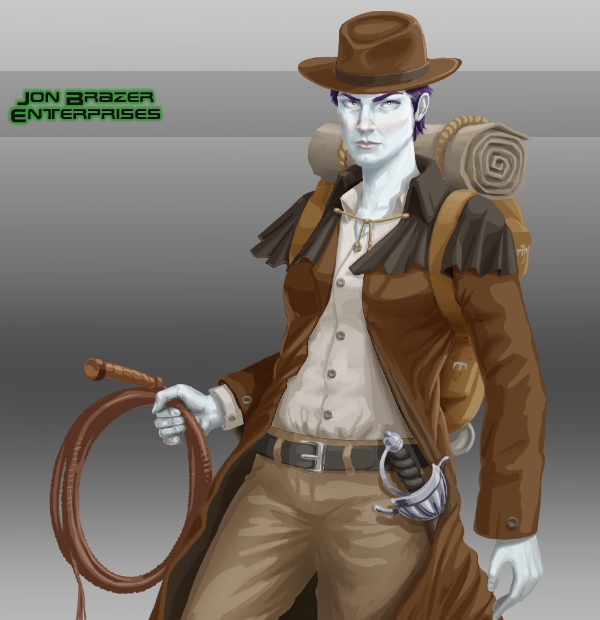
Edward grew up a noble but renounced his birthright because of all the political games he had to play. He did run away, stealing to survive from that day forward. It was the Princess Yolanda that made him trust again. So when the King caught Edward and Yolanda together and he talked with them, Edward trusted the King as well. Now he adventures to prove himself worthy of the Princess’ hand and the King’s approval, trying to amend his past crimes.

Edward stands tall on the cover of Deadly Delves: Rescue from Tyrkaven. Download this adventure for Pathfinder and Fifth Edition. Download these and all of our books today using coupon code “holiday2017” to get 30% off this and everything else at the JBE Shop now through January 31, 2018.

Pathfinder: Aberrant Fruitcake

Ah, what a wonderful time of year it is. Holiday music is being promoted to us on our devices. Our family is bugging us to come over. So today, I thought I would top that off with everyone’s favorite holiday food: a fruitcake. This year, why not show the holidays how much you love these parts of it by sticking a sword right through it. It is so therapeutic to be able to do that from time to time.

Aberrant Fruitcake CR 5

XP 1,600
NE Medium aberration
Init +2; Senses darkvision 60 ft.; Perception +8


Defense


AC 18, touch 12, flat-footed 16 (+2 Dex, +6 natural)
hp 45 (7d8+14)
Fort +3, Ref +4, Will +6
DR 5/magic; Immune aging effects, negative energy damage


Offense


Speed 40 ft.
Melee 2 claws +8 (1d4+3 plus grab), bite +8 (1d6+3)
Special Attacks pounce, sticky


Statistics

Str 16, Dex 14, Con 12, Int 4, Wis 12, Cha 6
Base Atk +5; CMB +8 (+10 drag, +12 grapple); CMD 20 (22 vs. drag, 24 vs. overrun, trip)
Feats Improved Drag, Power Attack (–2/+4), Toughness, Vital Strike
Skills Acrobatics +7, Perception +7, Stealth +7
Languages Undercommon (can’t speak)
SQ entropic preservation


Ecology


Environment cold forests and underground (Plane of Shadows)
Organization solitary or pack (2–5)
Treasure none


Special Abilities


Entropic Preservation (Su) An aberrant fruitcake is immune to all types of aging effects, whether natural or magical.
Sticky (Ex) A weapon that strikes an aberrant fruitcake is stuck fast by a strange adhesive unless the wielder succeeds on a DC 14 Strength check. An application of strong spirits thrown on the aberrant fruitcake reduces the DC of the Strength check to 10 for 1 round. An application of universal solvent will automatically dissolve the sticky fluid. An aberrant fruitcake can dissolve its adhesive at will. The DC is Constitution-based.

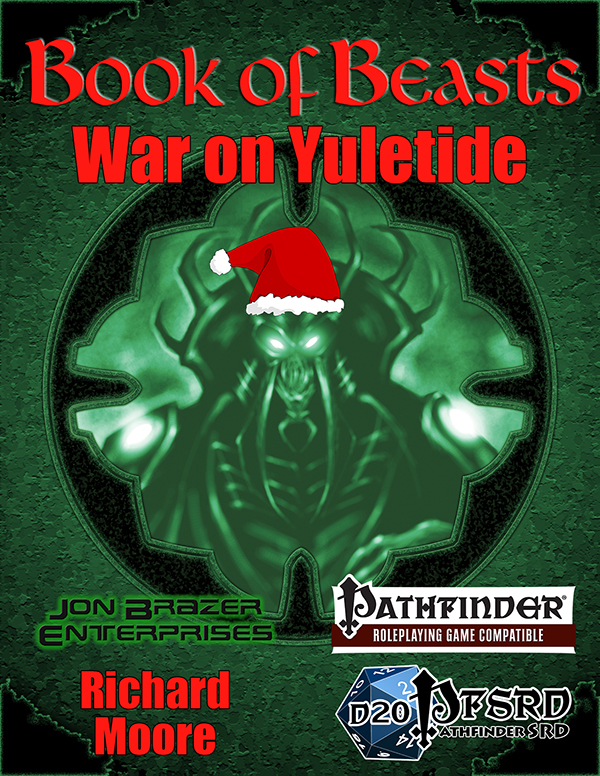
Download the Book of Beasts: War on Yuletide today at JonBrazer.com. Use the coupon code “holiday2017” and get 30% off this and everything else at the JBE Shop from now through January 31, 2018. Download today.

13th Age Compatible: Unleash Fighter Talents and Maneuvers On Your Game

Fight With Your Own Style

Rush into battle! Take the impossible blow! Dare your enemies to face you! Fighters are the point of any adventuring group’s spear, and their fighting styles are as unique as they are. Now you can go beyond the core book and show off new fighting talents and maneuvers to define your character.

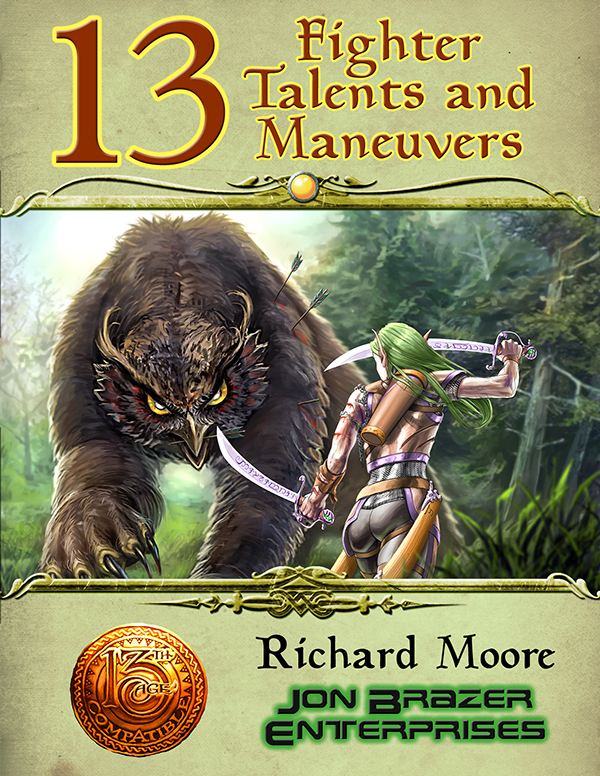
13 Fighter Talents and Maneuvers is the first in our 13 Class Options series for the 13th Age Roleplaying Game. Inside this 9-page PDF, you will find:

  • 4 New Fighter Talents, including First To Arms to claim the highest initiative and Taunt to draw the ire of an enemy
  • 5 Heroic Fighter Maneuvers, including options to daze an enemy upon a miss or deal ongoing damage
  • 2 Champion Fighter Maneuvers, including the ability to pin your enemy to a wall
  • 2 Epic Fighter Maneuvers, such as the ability to rain arrows down upon your enemies

Fight on your own terms and in your own way in the 13th Age.

Download 13 Fighter Talents and Maneuvers today at the JBE Shop. You can also find it at DriveThruRPG/RPGNow and the OpenGamingStore.

13th Age: Fighting Your Way

With the release of 13 Fighter Talents and Maneuvers tomorrow, we’ll be back next week with our regularly scheduled Traveller vehicle next week. Today we are bringing you a pair of class options for the 13th Age fighter.

Not long ago, I approached Richard Moore, our resident 13th Age expert, with the idea of a new series of class options for the game, each consisting of 13 new abilities. Now, PDF supplements focused on class options are nothing new. Many companies made their names doing just that for Pathfinder. However, 13th Age supplements covering individual classes are much rarer. He thought it was a great idea and give it a go. Here are two of the options in the first in the series he turned in.

New Fighter Talent

First To Arms

At the start of a battle, you may spend a recovery in order to go first (effectively claiming the highest initiative). If more than one creature in a fight uses this maneuver, the creature with the highest Dexterity modifier goes first (roll 1d20 to break ties).
Adventurer Feat: You gain a bonus to your AC equal to the higher of your Dexterity or Wisdom modifier until the escalation die is equal to your level.
Champion Feat: You also gain a bonus to your PD equal to the higher of your Dexterity or Wisdom modifier until the escalation die is equal to your level.
Epic Feat: You may spend a recovery at the start of a battle to take a full turn before everyone else does and then still roll initiative normally, taking your usual turn on that initiative count.

New Fighter Maneuver

Left You An Opening (3rd-Level Maneuver)

Flexible melee attack
Triggering Roll: Any natural even miss, when the escalation die is 2+
Effect: You forego miss damage against the targeted enemy in order to give a nearby ally double the escalation bonus on their next attack roll against that same enemy.
Adventurer Feat: The targeted enemy also becomes vulnerable to your affected ally’s next attack.
Champion Feat: The affected ally also gains an extra WEAPON die to their next damage roll against the same enemy.

13 Fighter Talents and Maneuvers comes out tomorrow for the 13th Age Roleplaying Game. Download all our 13th Age products at the JBE Shop. You can also find them at DriveThruRPG/RPGNow and the Open Gaming Store.

5 Questions Every Bard Should Be Able to Answer

“Why did you think going into the dungeon and singing at the monsters was a good idea?” Let’s just agree that the idea of going into a deadly location armed with a tune is silly concept, at least at first glance. Yet, no one will hear of the hero’s exploits unless someone that is skilled at retelling the tale of heroic is there to witness them. In so doing, they have to know how to stand their ground and meet dangers head on. So it makes sense that they would use what they are best at to full effect.

To help you flesh out your character, we have 5 questions for you that you, as the player of the bard should be able to answer through your character’s eyes. If you prefer to play a fighter, cleric, or monk, we have 5 questions for them as well. So lets begin.

1) How Long Have You Been Training?

Anyone can move to music. Anyone can pick up an instrument, blow on it or pluck a string, and make noise. Anyone read words on a page while changing pitch. These, however, are not the product of years of training, dedication, and long hard work. That is what you have done. Day in and day out you played your lute until it comes to you as easily as breathing. You strengthening certain muscles while hammering your dulcimer, carrying your tuba, lifting your trombone again, and again, and again. Imagine what it was like, being a child on stage performing your dance routine and years later still performing. Not only are you good, you are captivating, enthralling, mesmerizing, inspiring. Your performances are quite literally magical. What were those long days like? Did you enjoy them or were they downright torture? This is actually the perfect intro to the next question…

2) Why Did You Start Training and Keep Training?

First off, why did you start? Did it seem like fun? Did you try it out and liked it? Were you forced by your parents for some village or clan festival? Trying it is one thing; continuing it is another. Children are notorious for trying something and stopping the moment it gets hard. So why did you stick to it? Did you tell your parents you wanted the instrument, they got it for you, you were unhappy when it got hard and your parents made you continue after they spent the money for it? Did they tell you how proud they were of you for doing so? Were you determined to earn someone’s approval by playing hard? Were you trying to emulate the local performer? What made you keep going when it was hard?

3) How Did You Learn a Bit of Everything?

Bards may not be experts in any one area, but they are darn good at just about everything. They may not be front line fighters but they know how to use a number of weapons well. They may not have the spell breadth of a wizard, but they do have a solid number of spells. Their skill selection is diverse. How are you so well educated, so much of a jack of all trades? Did you get sent to college or did you go to the school of hard knocks? Was far more expected of you than most others or were you naturally gifted at learning anything you were shown once. How are you so good at everything?

4) What Drives You To Be Better?

While this answer should always be, “To be better than I was yesterday,” what fun is there in that? If anything this is a great end point for your character—coming to a point where you are in competition with no one but yourself—but not a good starting point. This is a point of professional conflict with your character. Are you trying to be better than someone you consider your equal, that started around the same time as you, but got all the recognition that you feel you deserve? Perhaps you want to be just like your hero, the one person that got you into performing in the first place. Maybe you have this idealized version of yourself and you are forever striving for it but never attaining it. Over the course of the campaign, you should come to terms that you are only in competition with yourself, and talk to your GM about wanting to explore this in the campaign. Maybe your rival or hero can play a part in the campaign and your character can find a kind of peace when they finally see the truth of the situation. This will make your character engaging long after the campaign is over.

5) What “epicness” does your current group of companions present?

If you are going to tell the tale, sing the songs, perform the scene of the exploits of your character and their adventures, their deeds should be worthy of tales, songs, and plays. Maybe they haven’t done anything yet, but you see the spark inside them. What is it that makes you believe in them, and how does being with them make you believe in yourself more?

Sharem is our signature transman samsaran bard. He remembers himself playing instruments and telling tales in previous incarnations and started playing to connect with his former lives. That is what kept him practicing year after year growing up. Today he is more of an actor than a musician. He makes his performances showy, using his whip whenever possible to swing over the audience. He uses similar showmanship when in the dungeon as well. By keeping the monsters’ attention on himself, his companions can take them down with ease.

Sharem and his fellow adventurers are on the cover of the adventure Deadly Delves: The Gilded Gauntlet. Download this Pathfinder book today using coupon code “holiday2017” to get 30% off this and everything else at the JBE Shop now through January 31, 2018.

Pathfinder: Memitim Psychopomp

When it comes to ferrying the dead off to their afterlife, preventing them from haunting the living, I think Christmas. Well, a Dickens-inspired Christmas, at least. Of course there’s the holiday classic movie, It’s a Wonderful Life, or the 80’s variation I grew up on, One Magic Christmas. In more recent times my times my wife is a huge fan of the The Family Stone. What can I say, Christmas entertainment always involved quite a bit of death when I was a kid. That and someone saying, “you’ll shoot your eye out,” but that is beside the point.

Not long ago, I concluded a series where I was expanding the list of monsters on the summon monster lists. Well, given the season and my odd association, I submit the memitim psychopomp to be added to the summon monster IX list, if you are including Pathfinder Compatible supplements on the list of monsters you be summoned to the battlefield.

Psychopomp, Memitim

One arm covered in heavy metallic armor and the other covered in rune-like tattoos, this winged figure is both escort and executioner of the lost.

Memitim CR 14
XP 38,400
N Huge outsider (extraplanar, psychopomp)
Init +6; Senses darkvision 60 ft., low-light vision, spiritsense 60 ft.; Perception +28


DEFENSE


AC 29, touch 14, flat-footed 23 (+5 armor, +6 Dex, +10 natural, -2 size)
hp 199 (19d10+95)
Fort +16, Ref +12, Will +17
Defensive Abilities hidden body; DR 15/adamantine; Immune death effects, disease, poison; Resist cold 10, electricity 10; SR 28


OFFENSE


Speed 40 ft., fly 60 ft. (average)
Melee +1 mighty cleaving speed scythe +22/+22/+17/+12/+7 (3d6+7/19-20/x4)
Space 15 ft.; Reach 15 ft.
Spell-Like Abilities (CL 14th; concentration +18)
At Will–dispel magic, halt undead (DC 17), vampiric touch
3/day–bestow curse (DC 18), quickened dispel magic
1/day–finger of death (DC 21), undeath to death (DC 20), wavesof exhaustion


STATISTICS


Str 19, Dex 22, Con 20, Int 16, Wis 23, Cha 18
Base Atk +19; CMB+25; CMD41
Feats Combat Casting, Combat Reflexes, Craft Magic Arms and Armor, Greater Spell Penetration, Improved Critical (scythe), Hover, Master Craftsman (Craft [weapons]), Quicken Spell-Like Ability (dispel magic), Spell Penetration, Vital Strike
Skills Craft (weapons) +25, Diplomacy +26, Fly +24, Intimidate +26, Knowledge (religion, planes) +25, Perception +28, Sense Motive +28, Stealth +20
Languages Abyssal, Celestial, Common, Infernal, Shadowspeak, Undercommon
SQ ghost touch


ECOLOGY


Environment any (Plane of Shadows, Purgatory)
Organization solitary
Treasure standard (huge +1 mighty cleaving speed scythe, huge +4 full plate armor (arm only), other treasure)


SPECIAL ABILITIES


Armor While a memitim wears no armor, its left arm is made out of metal armor. Because it is a part of the memitim, it takes none of the penalties of wearing armor. If this arm is cut off, a huge size creature can wear it immediately as the arm from a suit of Huge +4 full plate armor. The arm possesses a maximum Dex bonus of +1, armor check penalty of -7, 35% arcane spell failure, no reduction in base speed, and weights 40 lbs.

Ghost Touch (Su) A memitim treats all natural and wielded weapons as if it had the ghost touch ability.

Hidden Body (Su) It is harder to score additional damage against the memitim due to the concealment provided by its long robe. When a critical hit or sneak attack is scored on the memitim, there is a 50% chance that the attack deals normal damage.

Spiritsense (Su) A memitim notices, locates, and can distinguish between living and undead creatures within 60 feet, just as if it possessed the blindsight ability. When the god of life and death selects a being to die. The marked one meets his death at the place and time appointed. Should his soul or body continue on and become one of the unliving, the memitim returns it to its intended destination—by force, if necessary.

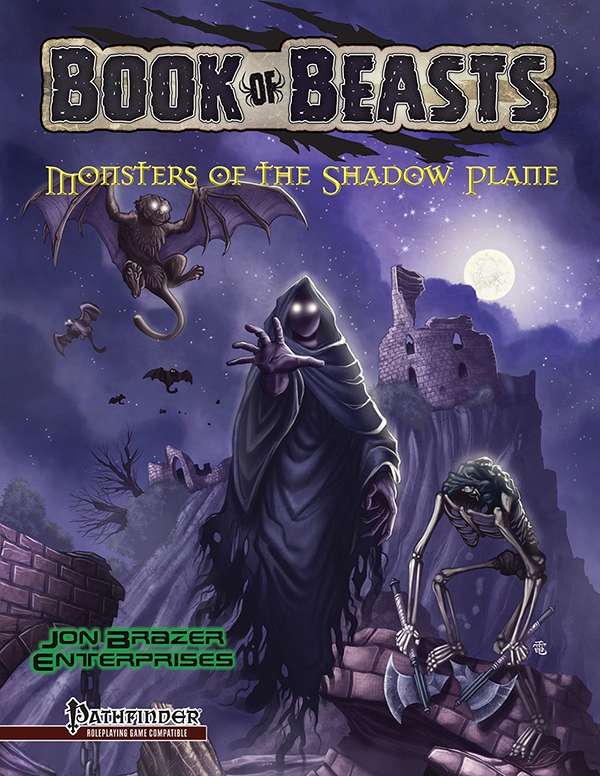
This psychopomp first appeared in the JBE release Book of Beasts: Monsters of the Shadow Plane. Download this monster book today at the JBE Shop.
Traveller: Hypercycle

For this week’s vehicle, I bring you the Cornathian Hypercycle. Unlike previous vehicles we showed off here at JonBrazer.com (Zargrav X-72, Zaspa T-68 Skyhopper, and Cyberpuma) this isn’t a conversion from MGT 1e to 2e. This is a new vehicle we created specifically for this edition of the game.

The Hypercycle is a wheeled motorcycle for adrenaline junkies. It has the agility to weave through traffic and the raw speed to bypass everything on the road when they have the space. Not only that, it is about a third of the cost of the Imperium’s g/bike. This is a great common man’s on the border worlds.

Hypercycle

TL 10
Skill Drive (wheel)
Agility +2
Speed (Cruise) Fast (High)
Range (Cruise) 500 (750)
Crew 1
Passengers 1
Cargo
Hull 4
Shipping 1 tons
Cost Cr. 17,000

Armour

Front 3
Rear 3
Sides 3

Details

Autopilot (skill level) +0
Communications (range)
Navigation (Navigation DM) +1
Sensors (Electronics [Sensors] DM) +0, 1 km
Camouflage (Recon DM)
Stealth (Electronics [sensors] DM)

Traits/Equipment

Autopilot (Basic), Control System (Improved), Navigation (Basic), Open Vehicle, Sensors (Basic)

The Hypercycle is produced by in the Cornathian Empire. Find details about the Cornathian Empire in Foreven Worlds: Fessor Subsector. Download this at JonBrazer.com. You can also find it at DriveThruRPG and RPGNow.

5 Questions Every Monk Should Be Able to Answer

Monks may not have been in every edition of d20 fantasy games, yet most accept them as one of the core classes. If your only exposure to what a monk should be is by watching Kung Fu or by watching bad (awesome!) martial arts movies, then I recommend checking out a few other sources of inspiration. High up on my list is the movie Spring, Summer, Fall, Winter … and Spring. It is an excellent movie about the life of a monk. It can help you see a monk as a complex person rather than just someone that wanders around spouting nonsense and calling it wisdom (wah). You could also sign up for some martial arts classes and understand first hand the discipline a monk possesses. Unlike learning sword fighting and casting spells, martial arts classes are relative common and should be taken advantage of if you want to understand how a monk sees the world.

If you want to play a monk, here are five questions that will help you get into your character. See our 5 Questions for fighters and clerics here.

1) Were You Born To This Life, Or Did You Choose It?

The fundamental question, how did you get here? This will alter your world view. If you were raised from a small child to be a monk, you will see their ordered way of life as the only natural way to live. Such an austere lifestyle will be something you do not even question. You will recognize the importance if breathing and how it relates to life and fighting. However, you may always wonder who your parents were and why you were sent to the monks. If you joined a monastery later in life, you may choke at the lack of pleasures, chafe at the rules. Like Doctor Strange, you find it difficult accepting their ways and practices. Yet you choose this life for some reason. What happened that made you see this lifestyle as better than the one you previously choose.

2) Why Did You Start Adventuring?

Unlike classes like fighter and ranger that pretty much require adventuring, monk is one of those classes where it would be completely normal to stay in the building where you train and never go adventuring. So why did you? Did your master send you out in the world to gain experience (not XP) so you can achieve a higher plane of enlightenment? Perhaps you walked out of your own accord, not feeling that the reasons you originally joined changed. Did “real” life happen, like a family member die and you are now just wondering around looking for answers before returning to the monastery? For one fleeting moment, did you achieve enlightenment and now are trying to reattain it?

3) What Do You Think Of The World Outside the Monastery?

Now that you have spent time in the monastery, what is it like going out into the world? If you were raised by monks, this place would be strange, almost alien in the way that people do not treat each other with respect and honor. If anything, the monsters of the world might be more familiar to you since you probably have seen your fair share of them, being away from civilization. If you were raised in civilization and choose the monastic life and then returned to civilization, you would definitely be surprised by how your perspective has shifted. Things that once seemed normal to you would seem completely unreasonable. Your “fish out of water” point of view should be evident whenever you enter town.

4) How Do Your Actions Demonstrate Your Philosophy?

Being a monk means you have a philosophy, a way of looking at the world that is part practical, part mystical. Unlike lawful religion that sees things in start terms—good and bad, holy and unholy, worthy and unworthy—monks tend see the world through the lens of discipline because of their rigorous training. But the specifics of what your monk philosophy are up to you. The real question is how does your actions demonstration what that philosophy is? Do you believe in only defending and will only attack those that attack first? Will you always give someone the option to surrender? Are you careful where you step, always cautious of stepping on a bug or a worm? Will you have tea with your enemies? Always think how your actions are different than a typical fighter. They should be very visible to everyone.

5) What Do You See In Your Fellow Adventurers

For a monk to travel with adventurers is a great honor. It shows that they are worthy of you. What do you see in them in worthy? What sets them apart? You should be able to answer that for each of the characters.

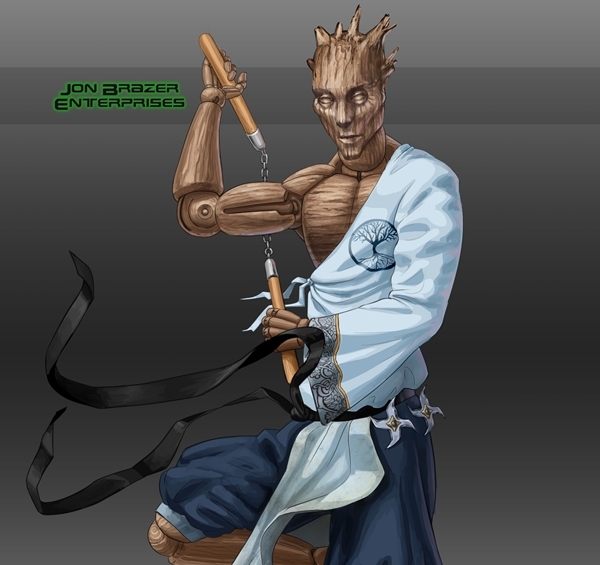
Emberwood choose to join the Cragtree Monastery at age 407. Before then, it found life confusing. Humans did not make any sense. The monks were the first such humans that were logical and saw the world in much the same way. All the other students admired Emberwood for his ability to meditate endlessly, since it did not need to eat or sleep. Now that he is over 1,000 years of age, he is the last of his monastery. The numbers of the Cragtree Monastery dwindled over the intervening centuries and yet Emberwood stayed. It was only the building collapsing under it that broke it from meditation. In all that time, Emberwood never achieved enlightenment like the other monks had. It recalled the words of one of an old master, that enlightenment sometimes comes from strange places. So it went in search of those strange places. It continues to meditate every morning but then continues on seeking what it had not yet achieved.

Emberwood is featured on the cover of the Book of Heroic Races: Advanced Compendium for the Pathfinder Roleplaying Game. Do you prefer 5e? Download his kind’s racial traits today in the Book of Heroic Races: Player Races 2. How about 13th Age? Download the Book of Heroic Races: Age of Races 2 today. Be sure to use coupon code “holiday2017” to get 30% off this and everything else at the JBE Shop now through January 31, 2018.

Happy Hogswatch (Or Whatever You Celebrate)

From now through Festivus and all the way through January 31, 2018, you can download anything JonBrazer.com and get 30% off your entire order with the “holiday2017” coupon code. May your Yule be bright, your Saturnalia be joyous, your St Lucia Day be merry, your Kwanzaa be celebrated with family, your Hanukkah be will lit, and have a Merry Christmas. 

From all of us at Jon Brazer Enterprises, have a safe and happy holiday.